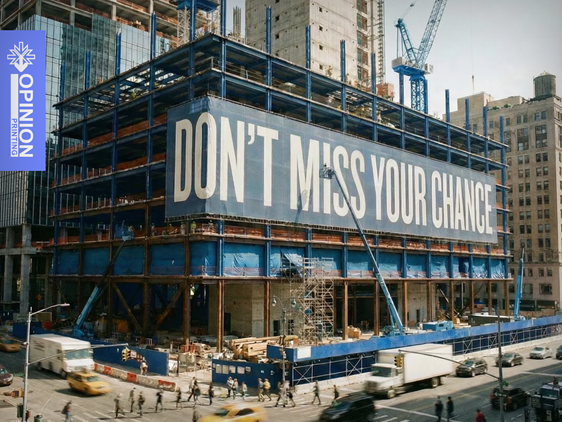
A large-format banner with the slogan “Don’t Miss Your Chance” mounted on the façade of a building under construction in a city center.
A construction site rarely looks representative – but it is almost always highly visible. Before the final result appears, for many weeks (and often months), it is the fences, scaffolding, and construction facilities that create the first impression. And that impression can work to your advantage if you treat the construction space as a communication channel rather than just a “necessary stage.”
Outdoor advertising during project execution has a simple advantage: it works 24/7 in a location that people pass by every day. It’s not about fighting for a click, but about consistently building brand recognition in the real world. How can you organize it so that it remains coherent, clear, and effective?
Why Is the Construction Phase a Good Time for Outdoor Advertising?
During construction, natural curiosity arises. People slow down, look behind the fence, and try to understand what is being built. You get this attention “as part of the location” – without competing messages nearby and without the distractions typical of the internet.
Importantly, time works in your favor. If the message is well designed, audiences become familiar with the project name, logo, and visual identity. Over time, it is no longer “some construction site,” but “that place I recognize” – and that familiarity shortens the path from noticing to genuine interest.
Scaffolding and Large Surfaces – When Does Large Format Make Sense?
If you have a large surface available, you can turn it into a strong landmark. Mesh banners or other large-format solutions can cover the “technical” look of a construction site while creating an impression of scale and professionalism.
Content is key. The most effective visuals are not those that simply show the building itself, but those that suggest context: surroundings, greenery, light, scenes of life. This builds emotion and makes it easier for the viewer to “fill in” the value. The larger the medium, the less text you need – one idea, one slogan, one direction.
It’s also important not to treat this purely as graphics. Material parameters, wind permeability, installation methods, and weather resistance must all be adapted to the realities of construction work and safety requirements.
The Fence as the Key Eye-Level Medium
The fence is often the only element that viewers see up close and have a moment to actually “read.” That’s why it’s worth using it as a more informative space compared to a large-format banner seen from a distance.
A narrative arranged along the fence works particularly well: a visual introduction, followed by benefits, then specific details, and finally a simple call to action. This layout guides the viewer step by step and structures the communication.
In practice, less and clearer is better than dense and chaotic. Installation height and protection against dirt or damage have a real impact on perception – outdoor advertising at a construction site stays in place for a long time, so it needs to look good not only on day one.
Information Boards That Don’t Look Like a Formal Obligation
An information board may be mandatory, but that doesn’t mean it has to look random. If you take care of aesthetics, consistency, and clarity, it becomes part of your brand image: “a professional team is working here; everything is under control.”
In practice, details make the difference: a structured layout, quality materials, space for updates, and readability after dark (where relevant). Updating content – even small elements – shows that the project is progressing rather than standing still.
Elements That Attract Attention Through Movement
Visually, a construction site is static by definition – it can look the same for weeks. That’s why moving elements can attract attention even from those who pass by daily. Flags, masts, or lightweight structures visible from a distance can act as signposts and strengthen location recognition.
If you are managing several projects simultaneously, a consistent system of such elements also builds the impression of scale and brand communication consistency.
Timing and a Cohesive Strategy – Communication That Grows with the Project
The best results come from a phased approach. At the beginning, focus on curiosity and a simple message: the name, a short promise, and direction on where to find more information. Over time, you can reveal more specifics: key advantages, timelines, availability, and final calls to action.
This matters because outdoor advertising at a construction site is a marathon. Content should evolve, update, and respond to the project’s current stage. Equally important is maintaining the media in good condition – a torn banner, faded print, or outdated message can damage the effect more than having no advertising at all.
Summary
A construction site can be merely a technical phase – or a consistently managed communication space that builds recognition and credibility from the very first works. Well-planned outdoor advertising structures the message, familiarizes audiences with the project name, and ensures that the location works for your brand every day, regardless of time or weather.