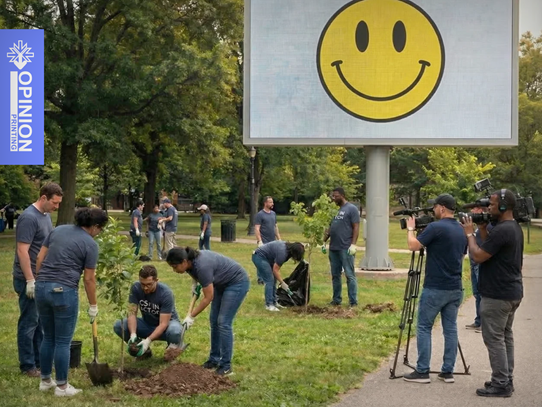
Today, many companies declare that they are involved in corporate social responsibility initiatives. However, only some of them turn those declarations into campaigns that genuinely engage audiences and lead to real change.
Why does this happen? Most often because CSR communication focuses on general slogans instead of specific problems and solutions.
An effective social campaign does not begin with a slogan, but with an understanding of the real needs of real people.
Instead of topics – specific problems
One of the most common mistakes in CSR communication is relying on vague statements. Phrases such as “we care about the environment,” “we support education,” or “we help the excluded” sound good in reports, but they rarely generate real engagement.
It is far more effective to show a specific situation that can actually be changed.
Instead of talking about “environmental pollution,” it is better to show how much waste ends up in a local river every year. Instead of declaring “support for seniors,” it is better to point to a specific group of people who gain digital skills through workshops.
This approach has two advantages.
First, it builds credibility.
Second, it makes it possible to plan actions that genuinely solve a problem.
Beneficiaries first, communication second
In many social campaigns, the people the project is meant to help only appear at the very end-as part of promotional materials. In reality, effective CSR initiatives begin with conversations with beneficiaries.
They know best what they truly need.
People experiencing homelessness may need access to a shower or a washing machine more than another meal distribution campaign. Teachers may expect support in the form of training rather than equipment they will not be able to use effectively.
Involving beneficiaries in designing solutions brings a double benefit: it increases the effectiveness of the actions and builds the authenticity of the entire initiative.
Engagement requires a well-designed process
Simply raising awareness of a problem rarely leads to real change. Effective social campaigns are designed with a clear engagement path.
The first step should be very simple-for example, a quick quiz, event registration, or participation in a short informational activity.
The next stages can gradually deepen engagement-from one-time participation in an event to regular volunteering or organizing initiatives within the local community.
It is worth remembering that people are more willing to get involved when they can see the tangible results of their actions. That is why many campaigns use elements of gamification, such as rankings, points for participation in initiatives, or local social challenges.
Communication also needs technical support
In social initiatives, visibility in public space also plays a huge role.
Materials such as banners, flags, backdrops, or citylights make it possible to reach local communities and expand the campaign’s reach.
Well-designed visual materials not only inform people about the initiative, but also strengthen its credibility and make it easier to organize events or social actions.
That is why many organizations and companies use solutions such as the Oprint.one platform, which enables the quick preparation and ordering of materials needed to carry out a campaign.
What matters is real impact, not just reach
In CSR communication, it is easy to focus on the number of views, clicks, or shares. Meanwhile, the most important question remains: did the campaign actually change anything?
Effective social initiatives primarily measure real impact:
how many people benefited from the program, what problems were solved, and what changes took place over the longer term.
At the very beginning of the project, it is worth defining the effect we want to achieve-from specific actions to long-term social change.
CSR as part of the company strategy
The most engaging social campaigns are not one-off image-building initiatives. They become part of the organization’s strategy and the way it operates.
Companies that treat social responsibility seriously stop asking how their actions will look in the media. Instead, they begin to focus on the real value they can bring to people and communities.
When CSR stops being an add-on to marketing communication and becomes part of a company’s DNA, social initiatives bring benefits both to society and to the business itself.