In offline sales, there is a moment that is often underestimated. The customer is already in the process, knows the offer, understands the product, but… still hasn’t made a decision. That’s exactly when the environment starts to play first violin. Not advertising in the sense of persuasion, but visual confirmation that they are dealing with a brand that is worth trusting.
In the physical world, this role is taken over by promotional and display materials. Their task is no longer to attract attention at all costs, but to close the purchase experience.
Offline decisions are made in the space
Unlike online, where the final stage of the funnel often ends with a click, offline sales happen in a real environment. The customer sees the space they are in, observes details, registers the consistency of communication-even if they are not doing it consciously.
That’s why a point of sale, a trade fair stand, or a showroom becomes part of the sales funnel. What is in the customer’s field of view at the moment of conversation or choice has a real impact on their decision.
Materials that don’t “sell” but reinforce
At the final stage of the purchasing process, calm, clear materials that are consistent with the brand identity work best. Their role is to strengthen the impression of professionalism, not to deliver intense promotional messaging.
A poster with a simple slogan, a stand placed in a logical spot, a graphic that organizes the space-these are elements that don’t compete for attention, but build the background for a decision. The customer doesn’t have to analyze the message. It’s enough that they feel confident in a given environment.
Visual consistency as a signal of credibility
One of the most common mistakes in offline sales is sensory overload. Too many messages, formats, and styles can break the sense of order, even if each element on its own is well designed.
Meanwhile, it’s precisely visual consistency that builds trust. Repeated colors, uniform typography, and logical placement of materials make the brand feel organized and predictable-qualities that strongly influence purchasing decisions.
Print as a “continuation” of the conversation
Printed materials have a special role in the offline funnel. A catalog, offer folder, or business card doesn’t work at the moment of exposure, but after it. It stays with the customer when they leave the point of sale or the booth.
Well-designed print doesn’t have to be extensive. What matters is quality, readability, and consistency with what the customer has already seen in the space. Such material doesn’t convince directly-it rather reminds them of a positive experience and reinforces it in memory.
An environment that supports the decision
More and more brands consciously treat space as a sales tool. Wall graphics, printed panels, or decorative elements don’t serve only an aesthetic function. They create a context in which the product and the sales conversation gain the right setting.
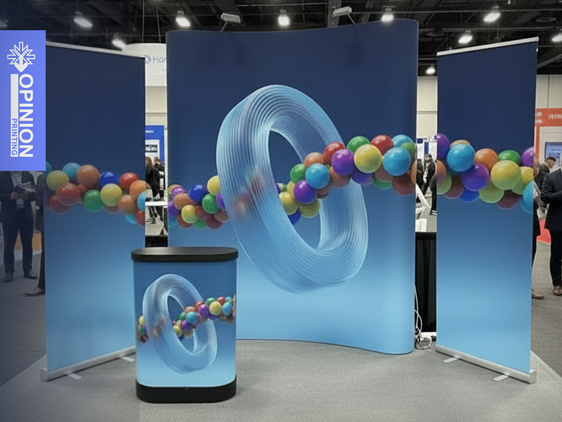
The same applies at trade fairs and industry events. A booth is not only a meeting place-it is a message in itself. A well-designed display can hold a viewer for a few seconds longer, and that is often enough to start a conversation.
Fewer stimuli, more meaning
At the last stage of the offline sales funnel, the winner is not the one who speaks the loudest. The winner is the one who can create a coherent, well-organized experience.
Promotional materials work best when they:
don’t compete with one another,
are matched to the place and the moment,
support the conversation instead of replacing it.
That’s where their strength lies-in simplicity.
When form completes the content
The end of the offline sales funnel is not the time for more arguments. It’s the moment when the customer needs confirmation that their choice is the right one. Well-designed visual materials don’t sell directly-they build a sense of confidence.
Posters, stands, spatial graphics, or printed offer materials create an environment in which a decision is made naturally. Without pressure, without pushiness. In the offline world, that’s what makes the biggest difference.